The staff is Amazing especially the MRI Tech she was patient and helpful due to my anxiety.
Ciairra Washington
 Google review
Everyday imaging
Open & High-Field MRI | Board-Certified Radiologists
Best Price Guarantee 4.9
Patient stories
Real patient stories from Advantis MRI & Diagnostic Imaging.
4.9 / 5from 1,000+ reviewsThe staff is Amazing especially the MRI Tech she was patient and helpful due to my anxiety.
Google reviewGreat customer service and gave me really good comfort while getting my MRI. I will recommend coming here for services.
Google reviewThey work to make sure things are comfortable and correct. Great place to get an MRI, if you have to.
Google reviewThis is my third visit to Advantis and I highly recommend them for x-ray and imaging needs.
Google reviewI've had 3 MRI's, one CT scan and one X-ray from this fine group. Very efficient and extremely friendly.
Google reviewVery clean and neat lobby and they have snacks!! Staff was wonderful and the tech was really quick and generous.
Google reviewUnderstand the examination
MRI uses a magnetic field and radio waves to create detailed internal images. A clinician may order it to examine the brain, spine, joints or other soft tissues. Your order identifies the area and whether contrast is needed; the imaging team confirms the appropriate protocol.
| Center | MRI equipment | Appointment guidance |
|---|---|---|
| Richmond Avenue | 1.5T closed MRI | General MRI; breast and prostate MRI use Dickinson. |
| Walters Road | High-field open MRI | Open MRI near Spring; no breast MRI, prostate MRI, DTI or full-body wellness screening. |
| Dickinson | High-field MRI | MRI appointments on Thursdays; confirm the next available date. |
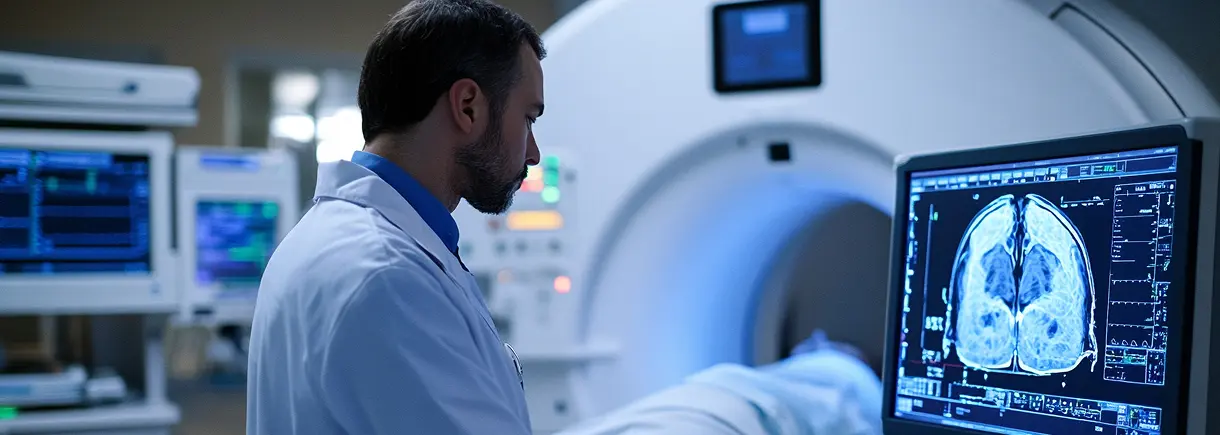
An MRI examination is a collection of image sets, rather than one photograph. The scanner measures signals from tissues after magnetic and radiofrequency changes. Different settings emphasize different features, so the radiologist can compare the same structure in several ways. A bright area on one image is therefore not a diagnosis on its own. The receiver used around the examined area helps collect these signals. The repeated changes in sound during scanning usually reflect the planned image sets. Staying still helps the sets line up and reduces the chance that movement hides a small structure.
The body region is only the starting point. A request to assess a ligament injury has different requirements from a request to characterize an organ finding. The referral should explain the clinical concern, previous treatment and any relevant earlier imaging. The imaging team uses this information when selecting coverage, sequences and whether contrast adds useful information. An examination described as comprehensive still has a defined scope. It should not be understood as a check of every organ, blood vessel and possible disease. If the referral has changed since an appointment was arranged, the updated clinical question matters as much as the new examination name.
MRI safety screening evaluates devices and objects as well as medical history. An implant being described as compatible is not enough information to decide how to scan it; some devices have conditions concerning equipment and scanning settings. A prior successful MRI does not establish that a new examination can proceed without review. Provide the device card or operative information when available, including anything implanted or changed since the last scan. Contrast is a separate decision from entering the scanner. Pregnancy, kidney disease and earlier reactions need an individual discussion when relevant. Do not remove a medical device or change treatment independently to prepare for imaging.
At the results appointment, start with the clinical question: what did the MRI explain, and what remains uncertain? Then distinguish an observation from a treatment decision. A finding can be real without being the main cause of a symptom, and a reassuring examination may not explain every symptom. Ask whether comparison with an earlier study would change the interpretation and which recommendations need action. If more imaging is proposed, ask what additional question it will answer. Keep the report and information about where the images are stored together, especially when several clinicians are involved. This helps the next conversation begin with the same evidence.
| Focus | What the study can add | What to keep in mind |
|---|---|---|
| Soft tissues | MRI can provide detail about organs, muscles, ligaments and other soft tissues. | The selected body region and sequences determine the coverage. |
| Brain and spine | Dedicated studies can assess brain tissue, spinal structures and nearby nerves. | A brain order does not automatically include the spine or blood vessels. |
| Contrast | Injected contrast can help answer certain clinical questions. | It is used according to the requested protocol and safety assessment. |
A doctor’s order is required before your scan. Tell the team about implants, previous surgery, pregnancy, kidney conditions and past contrast reactions before your visit. Bring an implant identification card if you have one. Follow your appointment-specific instructions on clothing, food and medication.
A brain MRI, a lumbar spine MRI and a knee MRI are different studies. Read the full examination name when you call, including the side of the body and any contrast instructions. If your order includes more than one region, ask whether these need separate appointments and estimates. Scheduling can confirm the protocol and center for your specific order.
Richmond Avenue and Dickinson list high-field MRI. Walters Road lists open MRI and serves the Spring and Cypress area from its Houston address. Choose around your examination requirements, comfort and travel plans. If your clinician needs a particular technique, ask the team to confirm it before selecting a location.
Ask for a written estimate for the exact study, with the radiologist’s interpretation and any contrast clearly accounted for. If using insurance, confirm the network status of the facility and interpreting provider for your plan. Have any authorization reference available and ask whether the office needs further paperwork before scheduling.
The team explains positioning and communication for the scan. Follow instructions about staying still and any brief breathing steps. Ask before the scan begins how to raise a concern, and tell the technologist if you need help.
Your radiologist’s report goes to the ordering clinician, who will explain the findings and next steps. Contact our records team for copies of your images or report.
Request images and reportsRequest an estimate for the examination on your referral, including contrast and radiologist interpretation. Confirm your plan’s network status and authorization requirements.
Costs, insurance & financingAvailable locations: Richmond Avenue, Dickinson. Confirm your exact protocol when booking.
View locations & hoursCommon questions
Ask the scheduling team to review your order for the Walters Road center. The scanner and protocol need to suit the examination your clinician requested.
Call 877-345-4244 with your order or request a callback. The team confirms the requested protocol, appropriate center and appointment options. A callback request does not itself confirm a booking.
Ask for a current quote for the exact study, including any contrast and the radiologist’s interpretation. Confirm separate charges and payment terms. If using insurance, check your plan’s network, benefits and authorization requirements.
Read each requested study to scheduling. Ask whether separate appointments or estimates are needed and whether any preparation instructions conflict. The office can obtain clarification from the referring clinician when necessary.
Ask which earlier images and reports are useful and how to transfer them. An existing scan may help comparison, but the clinical team determines whether it answers the current question or meets any specialized analysis requirements.
Arrange the report discussion with the clinician who ordered the examination or manages your care. Ask how the report will reach that office and when follow-up is appropriate. Records staff can help arrange copies for another provider.
No. Contrast is selected to answer particular questions; it does not make every MRI more informative. Some studies are designed without it. The relevant question is whether the planned protocol can answer the reason for your referral, taking your medical circumstances into account.
Movement or an incomplete breath hold can reduce image quality, and an additional view may be needed to complete the planned examination. A repeated sequence does not by itself indicate that a serious finding has been discovered. Ask the technologist what you need to do during the next set.
Yes. Advantis requires a doctor’s order for every scan, including self-pay appointments. You can request a callback before you have the order; it must be available before the examination.
Have your referral ready. Our team will confirm your scan, location and available appointment times.
The patient guide
MRI guidance
Your scan time and your total appointment time are different. Here is what to ask when planning your visit.
MRI guidance
A little preparation can make the day feel more manageable. Start with the instructions for your own examination.
Understanding imaging
Both make images inside the body, but they answer clinical questions in different ways.
Preparing for a scan
There is no universal fasting rule for every MRI. The correct instructions depend on your examination.
Understanding imaging
The contrast decision is part of choosing the right imaging protocol for your clinical question.
Understanding imaging
A clinician's assessment comes first. Back pain does not automatically mean you need an MRI.
