The staff is Amazing especially the MRI Tech she was patient and helpful due to my anxiety.
Ciairra Washington
 Google review
Specialized imaging
Brain Volume Measurement | Quantitative MRI Analysis
Best Price Guarantee 4.9
Patient stories
Real patient stories from Advantis MRI & Diagnostic Imaging.
4.9 / 5from 1,000+ reviewsThe staff is Amazing especially the MRI Tech she was patient and helpful due to my anxiety.
Google reviewGreat customer service and gave me really good comfort while getting my MRI. I will recommend coming here for services.
Google reviewThey work to make sure things are comfortable and correct. Great place to get an MRI, if you have to.
Google reviewThis is my third visit to Advantis and I highly recommend them for x-ray and imaging needs.
Google reviewI've had 3 MRI's, one CT scan and one X-ray from this fine group. Very efficient and extremely friendly.
Google reviewVery clean and neat lobby and they have snacks!! Staff was wonderful and the tech was really quick and generous.
Google reviewUnderstand the examination
NeuroQuant software measures volumes of brain structures from suitable MRI images. The measurements provide additional information for interpretation by a clinician; they do not independently diagnose a neurological condition.
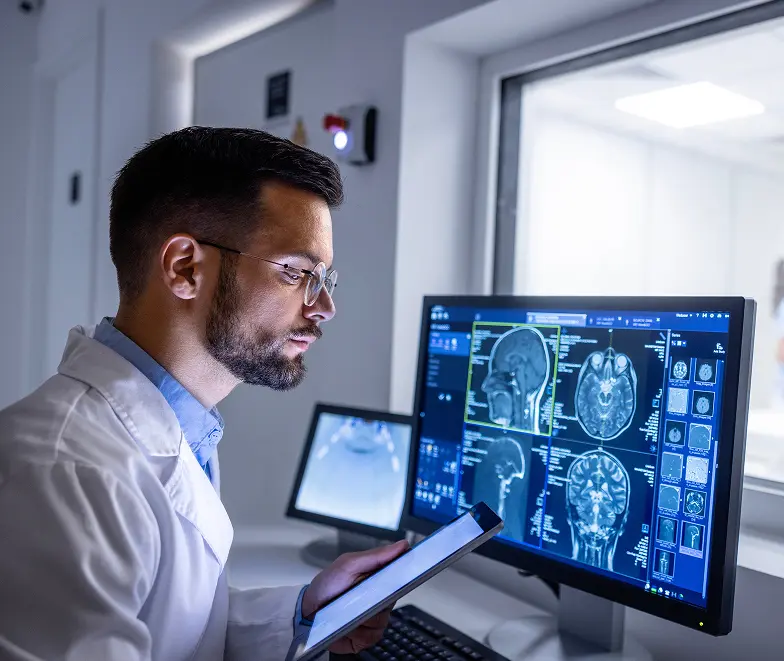
NeuroQuant is software that analyzes suitable brain MRI data to identify structures and calculate their volumes. This process, called segmentation, can produce numerical measurements and visual overlays that support a radiologist’s review. It adds a different form of information to the images rather than making the underlying MRI unnecessary. A clinician may use quantitative measurements when assessing a neurological question, but the usefulness depends on the question and the available image data. The report should remain connected to the radiology interpretation and the patient’s clinical assessment. A numerical result should not be presented as an independent explanation of memory symptoms or other neurological difficulties.
A percentile describes where a measurement lies within the reference data used for comparison. It is not the percentage of a brain structure that has been lost, and it is not a percentage probability of a particular disease. The reference group and report configuration matter when reading the output. Cortex measurements and other regional values can also be presented in different ways, so the report’s labels need to be explained before drawing conclusions from a single number. Ask the interpreting clinician which measurement is relevant, how the comparison group was selected and whether the numerical observation agrees with the appearance of the actual MRI images.
One examination compares the present measurement with a reference population. A series of comparable examinations may help a clinician consider the person’s own course over time. Those are different questions: a measurement near one end of a reference range may have been longstanding, while an apparently ordinary measurement does not reveal what that person’s earlier value was. Interpretation therefore benefits from knowing which previous images and reports are available and whether a meaningful comparison can be made. Ask whether the current study provides a baseline or a follow-up comparison, and whether any technical or clinical differences limit how much can be concluded from the change.
Quantitative brain analysis depends on suitable input images. Cortechs describes motion, acquisition problems and processing issues as reasons an examination may need review when the software does not produce a reliable result. A failed analysis does not automatically mean that a patient has an abnormal brain finding or that a whole new MRI is required. The clinical team first needs to identify the cause and determine whether the available data can be used. This distinction is useful when discussing existing images from another examination: a readable routine MRI and a dataset suitable for a particular quantitative tool are not necessarily the same thing. Ask whether the analysis was technically successful and whether any quality concern limits the interpretation.
An evaluation of memory or thinking difficulties can include a detailed history, assessment of daily functioning, cognitive testing, medication review and laboratory or other investigations. The National Institute on Aging explains that brain imaging may support the assessment or help identify other possible causes of symptoms. A volume measurement cannot replace that process. Describing when difficulties began and how they affect ordinary activities gives the clinician information a scan cannot supply. When appropriate, a family member or trusted person may help explain changes they have noticed. The useful question is how the imaging fits with that broader assessment, including whether different findings point toward the same explanation or leave additional possibilities to investigate.
A quantitative report may contain regional measurements, reference comparisons and color-coded overlays. The medical conclusion should explain which of those observations matter and why. Ask whether the output has been incorporated into the radiology interpretation or supplied as a separate document requiring specialist review. Keep the complete set together when sharing records. A later clinician needs to understand both the measurements and the interpretation, rather than receiving one graph detached from the examination that produced it.
| Focus | What the study can add | What to keep in mind |
|---|---|---|
| Volume measurements | NeuroQuant analyzes suitable brain MRI images to produce quantitative information. | The source images must meet the relevant acquisition requirements. |
| Clinical interpretation | Measurements can be reviewed alongside the images and clinical history. | An automated output is not a standalone diagnosis. |
| Comparisons | Prior suitable studies may be relevant when assessing change. | Confirm compatibility and the proposed analysis with the clinical team. |
A doctor’s order is required before your scan. Have your referring specialist's order available. Ask whether a new MRI acquisition is required, whether previous images are suitable, and which report the specialist needs. Confirm the center before booking.
The team explains positioning and communication for the scan. Follow instructions about staying still and any brief breathing steps. Ask before the scan begins how to raise a concern, and tell the technologist if you need help.
Your radiologist’s report goes to the ordering clinician, who will explain the findings and next steps. Contact our records team for copies of your images or report.
Request images and reportsRequest an estimate for the examination on your referral, including contrast and radiologist interpretation. Confirm your plan’s network status and authorization requirements.
Costs, insurance & financingCall with your referral and preferred location to confirm where your examination is available.
View locations & hoursCommon questions
A diagnosis requires a clinical assessment. Brain measurements are one possible input alongside history, examination and other investigations.
Call 877-345-4244 with your order or request a callback. The team confirms the requested protocol, appropriate center and appointment options. A callback request does not itself confirm a booking.
Ask for a current quote for the exact study, including any contrast and the radiologist’s interpretation. Confirm separate charges and payment terms. If using insurance, check your plan’s network, benefits and authorization requirements.
Read each requested study to scheduling. Ask whether separate appointments or estimates are needed and whether any preparation instructions conflict. The office can obtain clarification from the referring clinician when necessary.
Ask which earlier images and reports are useful and how to transfer them. An existing scan may help comparison, but the clinical team determines whether it answers the current question or meets any specialized analysis requirements.
Arrange the report discussion with the clinician who ordered the examination or manages your care. Ask how the report will reach that office and when follow-up is appropriate. Records staff can help arrange copies for another provider.
No. A percentile is a comparison with reference data, not a standalone disease diagnosis. A specialist considers the MRI appearance, symptoms, examination and other appropriate clinical information. An isolated low value should not be translated into a prognosis or a treatment decision without that context. Ask what the measurement contributes to the assessment and what other explanations or unanswered questions remain.
Not necessarily. A population percentile and a comparison of the person’s own measurements answer different questions. The interpreting clinician needs to consider what was measured, how the examinations compare and whether any difference is meaningful. Keep previous images as well as reports available for review. Ask whether the report describes an actual longitudinal comparison or only separate comparisons with reference data.
Not by itself. An analysis can fail because of image quality, acquisition or processing issues. The team should identify the reason before deciding whether additional imaging is necessary. Ask whether the existing examination remains clinically interpretable and whether the requested quantitative task can be completed from the available data or requires a different acquisition.
Describe the symptoms, their timing, effects on daily activities and any relevant medication or health changes. Cognitive assessment and other clinical investigations may also contribute to understanding memory concerns. Imaging is one component of that process. Ask the evaluating clinician which unanswered question the volume analysis addresses and how its result will be combined with the rest of the assessment.
Yes. Advantis requires a doctor’s order for every scan, including self-pay appointments. You can request a callback before you have the order; it must be available before the examination.
Have your referral ready. Our team will confirm your scan, location and available appointment times.
The patient guide
Vascular & specialized imaging
NeuroQuant adds brain-volume measurements to MRI interpretation. Learn what percentiles mean and which questions to ask your clinician.
MRI guidance
Understand the purpose of a head MRI, the questions to ask before booking and how to prepare for the results conversation.
