The short answer
MRA and CTA both assess blood vessels, using MRI and CT respectively. The appropriate choice depends on the vessel, clinical question and individual safety considerations. They are not interchangeable appointment labels, even when both are described as an angiogram.
- MRA uses magnetic resonance; CTA uses X-rays.
- Some MRA protocols do not require injected contrast.
- CTA typically uses an intravenous contrast injection.
- Report implants, kidney problems and previous contrast reactions.
- Confirm the vessel and body region on your order.
| Feature | MRA | CTA |
|---|---|---|
| Technology | MRI | CT |
| Ionizing radiation | No | Yes |
| Injected contrast | Depends on protocol | Usually part of the study |
| Preparation focus | MRI safety and protocol-specific instructions | Contrast review and protocol-specific instructions |
What MRA examines
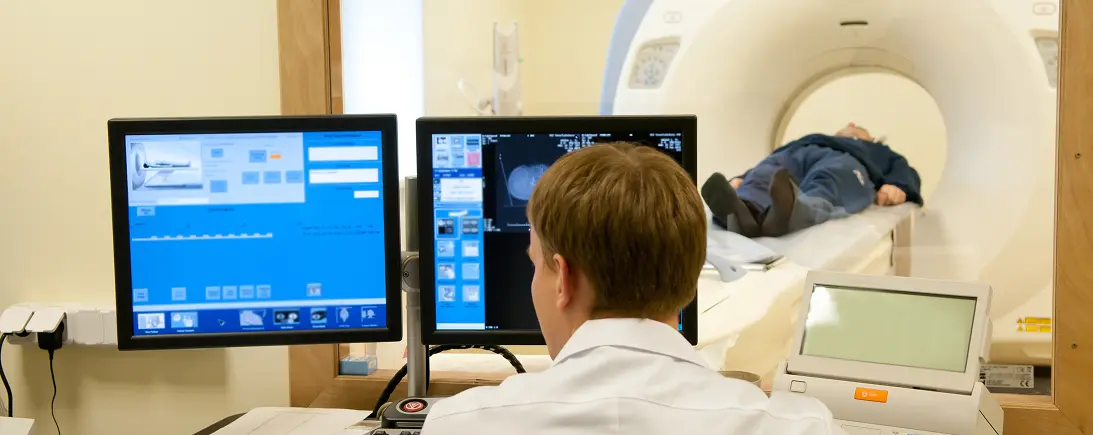
Magnetic resonance angiography is an MRI technique used to assess blood vessels. Depending on the protocol, it may be performed with or without a gadolinium-based contrast injection. It does not use ionizing radiation. As with other MRI examinations, implanted devices and retained metal need a safety review. Whether MRA is useful depends on the particular vessel and question; avoiding radiation alone is not a complete reason to choose it over an ordered CT study.
What CTA examines
CT angiography combines CT acquisition with an intravenous iodinated contrast injection to visualize vessels. Timing the images with contrast passage is part of the protocol. CTA uses ionizing radiation and has contrast-related considerations that the clinical team reviews. Ask which artery or vascular territory is being examined. A routine CT of the same body region may not provide the information needed from a specifically timed angiography examination.
The vessel and the clinical question define the study
Angiography means imaging blood vessels, but the requested territory still needs to be specified. A head MRA, a neck MRA and a CTA of the legs are not interchangeable examinations. Arteries and veins may also require different techniques. A general request for a vascular scan does not tell scheduling which images are needed.
Ask your referring office to clarify the body region and the question being investigated if the order is unclear. Explain whether earlier imaging identified a finding that needs follow-up and arrange access to those images. The useful comparison between MRA and CTA is which examination can answer that question in your circumstances, not which technology has the more impressive name.
Compare the preparation as well as the imaging method
Some MRA techniques can obtain useful vascular information without injected contrast. CTA generally uses an iodine-based intravenous contrast agent with carefully timed image acquisition. When contrast is required for MRA, it uses a different agent from CTA. A previous reaction therefore needs to be described by the actual examination, agent if known and symptoms, rather than simply recorded as an allergy to scans.
MRI also requires device and metal screening. Tell the team about implants and provide identifying information early. If you have kidney problems, the clinical team needs that history before deciding the contrast plan. Do not choose an alternative examination yourself on the assumption that it removes every risk; the radiologist and ordering clinician can assess the options.
Use the results appointment to understand the next decision
An angiography report may describe vessel narrowing, an enlargement or a finding that requires comparison. Ask which vessel is involved, whether the observation answers the original question and whether it changes your care. A report can contain technical measurements that need explanation before they become useful to you.
If more investigation is recommended, clarify the purpose of the next study. Another examination may provide information that the first technique cannot establish. Keep the complete report and images available for the specialist, especially if the consultation is at a different organization. Confirm transfer arrangements before the appointment so the visit is not spent trying to locate the scan.
How to compare the options with your clinician
Explain any prior difficulty with MRI, contrast reactions or relevant medical conditions to the referring clinician. Ask why the proposed method fits the clinical question and whether an alternative would answer it adequately. The decision may depend on speed, image detail, the vessel involved and individual safety factors. Do not change the booking yourself to a different technique because a friend's scan was easier or an online comparison presents one method as universally better.
Collect the details needed for safety review
Prepare the device card or manufacturer information for any implant, rather than relying on memory of its material. If you previously reacted to contrast, describe what happened, when and during which examination. Tell the team about kidney disease or dialysis and ask whether recent laboratory information is needed. Screening answers help organize a professional review; they do not establish clearance by themselves. If records are missing, ask how to obtain them before traveling.
Avoid an order mismatch at scheduling
Read the full order, including body region, side if relevant and contrast wording. Confirm whether the examination is MRA, CTA or another procedure such as catheter angiography. Advantis lists MR and CT angiography services; scheduling must confirm the specific protocol and appropriate center. Request preparation instructions for that protocol and a complete price or coverage check. Advantis requires the doctor's order before the scan, even when you pay privately.
After the scan: connect the report to the decision
Ask which clinician will review the result and whether earlier vascular images are needed for comparison. A report describing narrowing or another change should be discussed in the context of symptoms and the reason for imaging. Keep a record of any recommended follow-up. If an appointment with a specialist is already arranged, tell scheduling its date and confirm the report-transfer process without assuming a universal turnaround time.
Your Next-Step Checklist
- Read the body region and vessel study from the order.
- Identify earlier vascular imaging for comparison.
- Describe implants, kidney history and the details of any contrast reaction.
- Ask which clinical decision the result will inform.
Frequently Asked Questions
Is MRA always safer than CTA?
No single comparison fits everyone. The clinical question, implants, contrast considerations and other factors determine the appropriate examination.
Can a regular MRI replace an MRA?
Not automatically. An MRA is designed for vascular assessment; confirm the exact study with the referring office.
Should I stop medicines before angiography?
Ask for instructions specific to your examination and medicines. Do not stop prescribed treatment based only on a general article.
Is an MRA always done without contrast?
No. Some techniques do not require injected contrast, while others do. Confirm the protocol for your ordered study rather than assuming every MRA uses the same method.
Can I replace a CTA order with MRA myself?
Discuss the alternative with the ordering clinician and imaging team first. The techniques have different strengths and limitations, and the replacement may not answer the same question.
General educational information. Your examination and preparation depend on your clinical needs. Follow the instructions provided for your appointment.
Further reading: RadiologyInfo: MR angiography · RadiologyInfo: CT angiography