The short answer
Open, wide-bore and conventional MRI describe different scanner designs. The best fit depends on the ordered examination and your comfort needs.
- Open MRI and wide-bore MRI are different descriptions.
- Confirm that the scanner can perform the requested protocol.
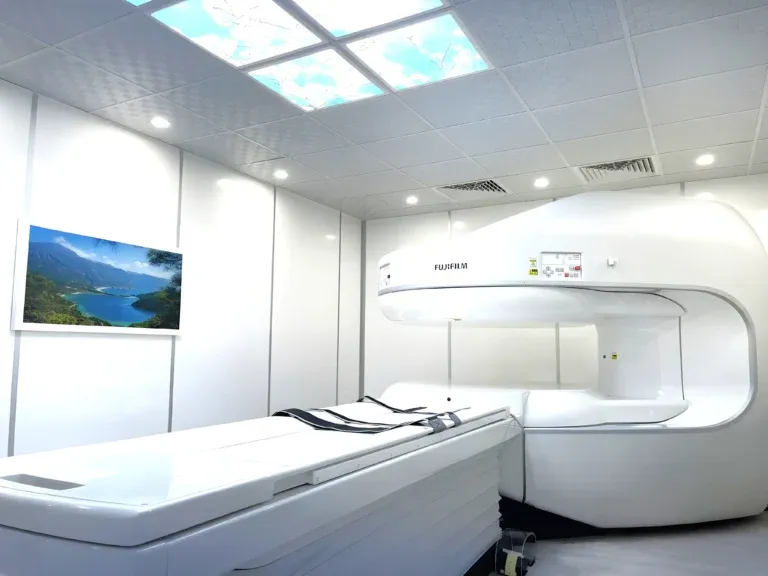
- Advantis lists open MRI at Walters Road.
| Design | What to clarify |
|---|---|
| Open MRI | The layout, your position and whether the requested protocol is available. |
| Wide-bore MRI | The opening dimensions and positioning for your body area. |
| Conventional MRI | How much of your body will be within the scanner for this study. |
| Any scanner | Suitability for your order, implants, access needs and comfort. |
Separate scanner design from the examination it can perform
An open MRI can be an option when an enclosed scanner is difficult to tolerate, but the available examination still matters. MRI systems differ in design and capabilities, and not every system performs every study. Choosing a scanner therefore involves both comfort and whether the equipment can produce the information requested. Share the precise body region, contrast wording and any specialized technique on the referral. Comparing photographs alone cannot establish suitability. If you have an implant, the safety conditions for that device also need to match the proposed MRI environment.
Position can matter as much as the size of the opening
The body area being studied must be positioned where the scanner can obtain the necessary images. Depending on the examination, a person may enter head first or feet first, and a coil may be needed near the area being imaged. A wider opening can feel different from a more open-sided design, but neither label tells you exactly where your head will be for your study. Ask the team to describe that position. This turns a general concern about small spaces into a concrete discussion about the examination you are actually preparing to have.
Compare four features separately
Scanner shape, field strength, receiver equipment and the imaging protocol all influence the examination. The word open describes a design; it does not tell you every technical specification or confirm availability of a particular study. Likewise, a closed scanner's field-strength number alone does not establish how comfortable you will feel during a specific examination.
Ask where the body part will be positioned, whether the head is inside the imaging area and what equipment sits around the region being scanned. Explain whether your concern is enclosure, shoulder width, pain, transferring onto the table or remaining still. A useful discussion addresses that actual concern instead of assuming one scanner label solves every difficulty.
Match the Advantis location to the ordered protocol
At Advantis, Richmond Avenue lists a 1.5T closed MRI, Walters Road a high-field open MRI and Dickinson a high-field MRI. Do not interpret these descriptions as an instruction to choose only by field strength. The team should confirm suitability for the requested body area, contrast plan and any specialized analysis.
For example, breast and prostate MRI are listed at Dickinson, while DTI and whole-body MRI arrangements are listed at Richmond Avenue and Dickinson. An open MRI preference needs to be discussed alongside those requirements. If the ordered study is unsuitable for the preferred setup, ask your clinician and imaging team about an appropriate alternative plan rather than booking a different examination yourself.
Start with the scanner design
Open MRI uses a design with more open space around the patient than a conventional tunnel-style scanner. Wide-bore and short-bore are other design descriptions. None of these terms alone tells you whether a machine is suitable for your particular study.
Open and wide-bore do not mean the same thing
An open scanner and a scanner with a wider tunnel can feel different, but the words describe different aspects of the equipment. Ask the center to explain the actual scanner rather than relying on a photograph from another facility. The position of the body part, any equipment placed around it and the required imaging technique also affect the experience. This is especially relevant if your main concern is where your head will be during the study.
Make the clinical and comfort decisions together
A useful comparison has two parts: can the equipment perform the ordered examination, and can you complete that examination comfortably enough to obtain useful images? Share both the referral and your concerns before the appointment is assigned. If a specialist has requested a particular technique, involve that office in any proposed change. Advantis identifies Walters Road as its open MRI location; confirm the particular study there before arranging travel.
If small spaces worry you
Say so before you book. Ask about communication with the technologist and how the team handles a pause if you need one. If medication is being considered, discuss it with the prescribing clinician and ask about transportation; do not arrange it on your own.
Open MRI at Advantis
The Walters Road location offers open MRI for the Spring and Cypress area. Richmond Avenue and Dickinson list high-field MRI. The scheduling team can help match your order to the right center and confirm availability.
Build a comfort plan around your concern
Be specific about what made a previous examination difficult. Was it the enclosed space, pain in one position, noise or uncertainty about communication? Ask how the team would address that issue for the study being planned. If medication is part of the discussion, agree on prescribing and transportation arrangements with the responsible clinicians beforehand.
Your Next-Step Checklist
- Describe the actual comfort or access concern.
- Ask about position and receiver equipment for your body area.
- Confirm protocol availability at the preferred center.
- Keep the clinical order unchanged unless the clinician revises it.
Compare equipment by Advantis location
Frequently Asked Questions
Is open MRI suitable for every body area?
Suitability depends on the protocol and available equipment. The team should review your order before confirming the scanner and location.
Does open MRI mean my head always stays outside?
Positioning depends on the scanner and examination. Ask the team to explain the setup for your body area rather than relying on the word “open.”
Is an open MRI automatically the best choice for every scan?
No. It may help some patients tolerate imaging, but the scanner still needs to support the requested examination. The referring clinician and imaging team should consider the clinical question together with comfort and safety. Do not change the intended technique only because the scanner name sounds preferable.
Can every MRI be performed feet first?
No. Position depends on the region and technique. Ask how you would lie for the particular order rather than relying on another patient’s experience. If the answer changes your ability to tolerate the examination, raise that early so the appropriate scanner and support can be discussed.
Does open MRI mean upright or standing MRI?
Not necessarily. Open describes the scanner design and should not be assumed to mean a standing examination. Ask the center about the actual equipment and position used.
Is all Advantis MRI performed on a 3T scanner?
No. Richmond Avenue is described as 1.5T closed MRI. Dickinson is described as high-field MRI without a 3T claim, and Walters Road offers high-field open MRI.
General educational information. Your examination and preparation depend on your clinical needs. Follow the instructions provided for your appointment.
Further reading: RadiologyInfo: body MRI · NHS: MRI scans · FDA: benefits and risks · NHS: having mri scan imaging department